Anatomy of a Whip
When we talk about a 3-foot or 5-foot whip, we're not referring to its total length. We're using a measurement convention — and to understand it, you first need to know what a whip is actually made of.
From the pommel to the cracker, a handmade whip is made up of several distinct parts, each with a specific role. Some wear out quickly, others last for years. Some are included in a whip's measurement, others are not. This guide gives you all the keys to understanding the complete structure of your whip and what our measurements actually mean.
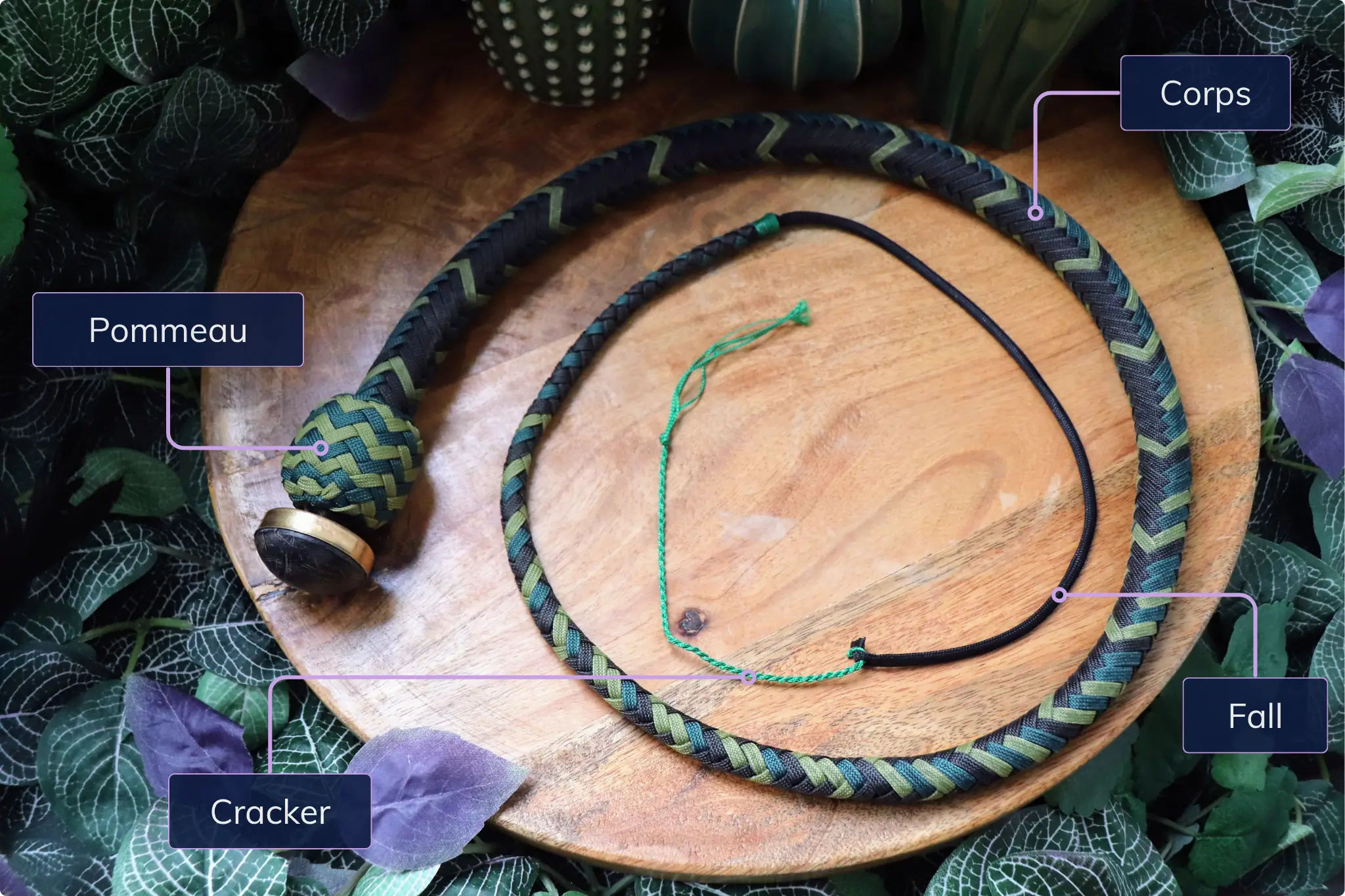
The cracker (or popper)
This is the thinnest and most visible part of the whip: the cracker, also known as the popper. It consists of strands, usually nylon or polyester, tied to the end of the fall. When the energy wave travels through the whip, the cracker exceeds the sound and produces that distinctive crack.
Our crackers are generally around 20 cm long. They are the most fragile and consumable part of the whip — fraying, shortening, or tangling with use. They are also the only part that comes into direct contact with the target during erotic or artistic practice, making them essential for precision and sensation.
To learn when and how to replace it, read our article: When to change your cracker.
The fall
Just above the cracker is the fall — an unbraided strap — usually made of leather or paracord that connects the braided body to the cracker. Its role is to transmit energy smoothly from the body to the cracker.
Its length varies depending on the whip's length and type. On some of our models, the fall is a replaceable part.
The thong (body)
The thong — also called the body — is the main part of the whip: the longest and heaviest section, the one that gives the instrument its dynamics, balance, and character. It stores and transfers the energy of the movement all the way to the cracker.
The whip is built from several braided layers surrounding a central core. At Eon's Whips, we use a traditional 3-layer construction, ensuring a smooth and progressive energy transfer while providing excellent strength and durability. This section — and only this section — is what is measured in feet.
On some of our entry-level models, we use a 2-layer braided construction. This design allows us to offer more affordable whips while maintaining a good performance.
The handle
The handle is the rigid section of the whip. Its purpose is to amplify and guide the motion. Different types of whips are distinguished by whether they have a handle or not:
Types of whips
- Snakewhip: no handle. The whip is flexible along its entire length.
- Bullwhip: the handle is integrated and measures around 25 to 35 cm. It is part of the braid and cannot be removed. Its rigidity increases power and facilitates advanced artistic techniques.
- Dualwhip: our exclusive model features a removable handle. It can be used with or without one, combining the advantages of both styles in a single piece. Without the handle, it behaves like a snakewhip.
The bullwhip handle is included in the stated length. The dualwhip handle, being removable, is not included in the measurement.
How is a whip measured?
The stated length of a whip refers only to its braided portion. For a bullwhip, this includes the handle + the thong. For a snakewhip or dualwhip, it refers to the thong alone.
The fall and cracker are never included in the stated measurement. Together, they generally add around 50+ cm to the whip's total length.
Here is a concrete example of typical dimensions for each whip type at Eon's Whips:
| Component | Snakewhip (3 ft) | Bullwhip (4 ft) | Dualwhip (3 ft) |
|---|---|---|---|
| Handle | — | ~30 cm (included) | ~30 cm (not included) |
| Thong (braid) | ~91 cm | ~92 cm | ~91 cm |
| Fall | ~30 cm | ~40 cm | ~30 cm |
| Cracker | ~20 cm | ~20 cm | ~20 cm |
| Stated length | 3 ft (~91 cm) | 4 ft (~122 cm) | 3 ft (~91 cm) |
| Total length | ~141 cm | ~182 cm | ~141-171 cm |
These measurements are indicative. The exact fall and cracker length can vary depending on the chosen configuration, intended use, and wear over time.
A coherent whole
Each part of the whip has a specific role, and it is their interaction that gives the instrument its personality. A well-chosen cracker can change both handling feel and precision. A properly sized fall improves energy transfer. A well-built body guarantees balance and durability. And the handle — whether present or not — defines the style of practice.
Understanding this anatomy means better understanding what you're ordering — and why the stated length doesn't match what you actually hold in your hands.
Questions? Ready to configure your ideal whip? Explore our whips or get in touch — we're here to guide you.